Usual Material of CNC Turning and Milling parts it’s Metal and Plastic materials. Metal include Steel,Aluminum Alloy , Copper Alloy and so on ; Plastic include POM ,PA,ABS,PTFE,PEEK and so on .
We welcome your customized Turning and Milling parts , these parts tolerance from +-0.05 to +-0.13mm.
Usual Material for CNC Turning and Milling Parts Is Metal and Plastic.So How we choose the Material ? Shenzhen E-booming Industrial have suggestions for you when you need customized turning and milling parts .
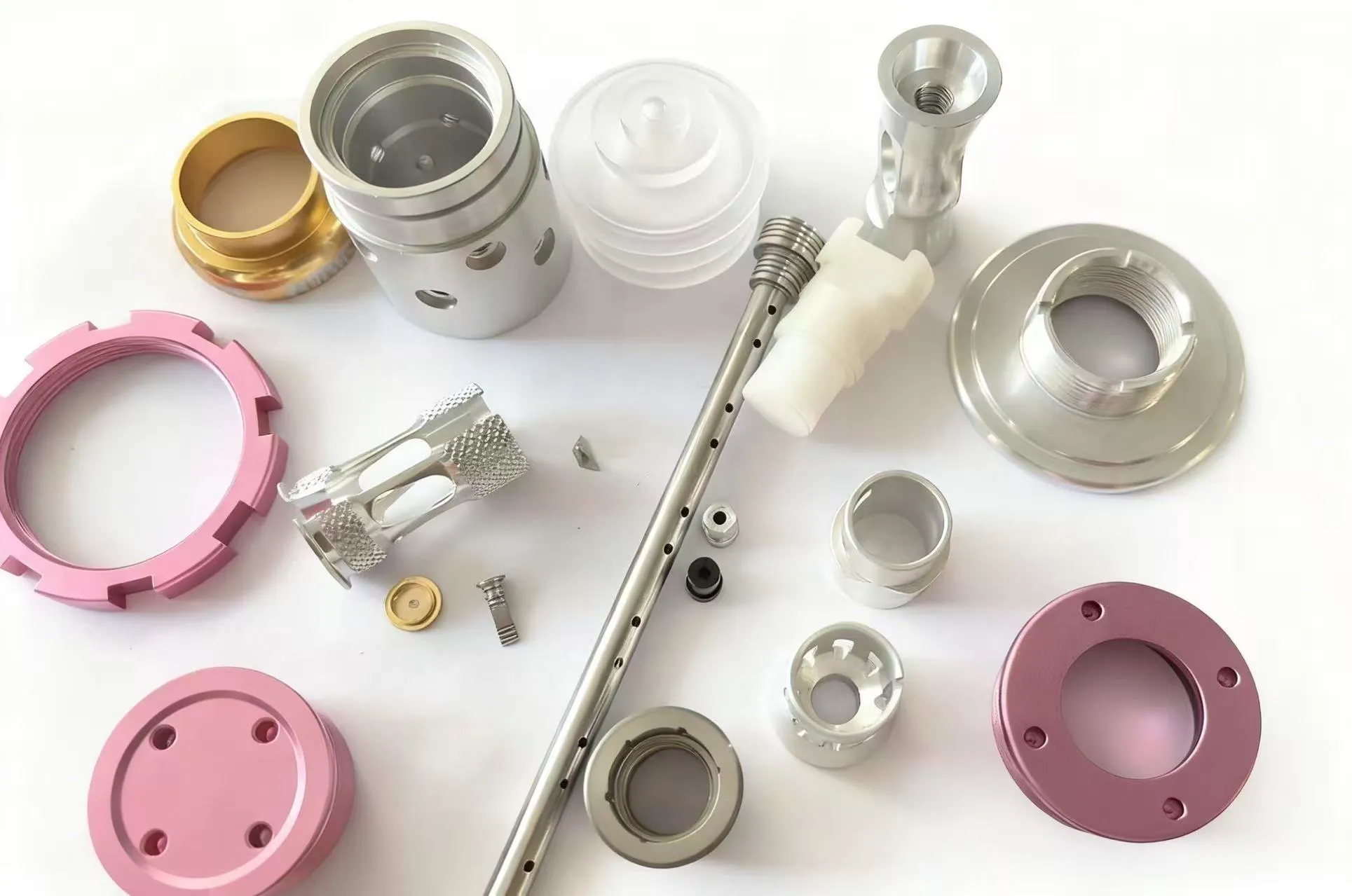
Metal Materials for CNC Turning & Milling Parts
1. Steel (Most Commonly Used, Accounting for Over 70%)
Carbon Steel (Q235, 45# Steel): High machinability and low cost. 45# Steel can be quenched and tempered for reinforcement, suitable for shafts, gears, nuts, flanges and other general structural parts.
Alloy Steel (40Cr, 20CrMnTi): High strength and wear resistance. 40Cr is used for high-strength shafts/connecting rods; 20CrMnTi is applied to gears and transmission shafts (requiring heat treatment).
Stainless Steel (304, 316): Corrosion-resistant and rust-proof. 304 is for general corrosion-resistant parts (e.g., fittings, valves); 316 is suitable for automotive exhaust systems and marine environment components.
2. Aluminum Alloy (First Choice for Lightweight)
6061, 7075: Good machinability and light weight. 6061 fits brackets, housings and connectors (excellent processability); 7075 has high strength, used for high-end transmission parts.
5052: Strong corrosion resistance, mainly for lightweight structural parts with low appearance requirements, and the surface is easy to anodize after processing.
3. Copper Alloy (For Conductivity/Heat Conduction/Wear Resistance)
Brass (H62, H65): Excellent machinability and ductility, used for oil pipe fittings, gears and bearing bushes (good friction reduction).
Copper (T2): Superior electrical and thermal conductivity, applied to electrical connectors and heat-conducting components, but prone to tool adhesion during processing.
Bronze (Tin Bronze, Aluminum Bronze): Extremely high wear resistance, suitable for bushings and liners in high-temperature and heavy-load scenarios.
4. Other Special Materials
Titanium Alloy (TC4): High strength, lightweight and corrosion-resistant, used for precision engine parts and chassis components of high-end vehicles, but with high processing difficulty and cost.
Cast Iron (HT200, QT500): Good rigidity and shock absorption, applied to machine tool beds and flywheels, but generates much dust during cutting, requiring special tools.
Plastic Materials for CNC Turning & Milling Parts
1. Commonly Used Plastic Materials (Ranked by Adaptability)
POM (Polyoxymethylene/Delrin): High machinability, no tool adhesion, excellent dimensional accuracy and wear resistance. Preferred for precision structural parts such as gears, bushings, nuts and guide sleeves.
PA (Nylon/Polyamide): PA6 and PA66 are mainstream, featuring wear resistance and impact resistance. Glass fiber reinforced (GFR) versions enhance rigidity, suitable for bearing bushes, connecting rods, gaskets and non-standard fasteners. Note chip removal during cutting.
PC (Polycarbonate): High rigidity, impact resistance and light transmittance, used for instrument housings, observation windows and precision brackets. Avoid high temperature-induced deformation during cutting.
ABS (Acrylonitrile-Butadiene-Styrene): Excellent processability and smooth surface, moderate cost. Applied to decorative structural parts, handles and joints, easy to grind and polish after cutting.
PTFE (Polytetrafluoroethylene/Teflon): High temperature resistance, corrosion resistance and self-lubrication, suitable for seals, valve cores and wear-resistant liners in corrosive environments. Low-speed processing is required to avoid deformation.
PEEK (Polyetheretherketone): High-end engineering plastic with high temperature resistance, high strength and chemical corrosion resistance. Used for precision shafts and seals in aerospace or high-end equipment, with medium processing difficulty and high cost.
2. Key Selection Points for Plastic Turning & Milling
Prioritize plastics with low viscosity and moderate crystallinity. Avoid soft (e.g., soft PVC) or extremely brittle (e.g., pure PS) materials to reduce processing defects.
Choose POM or glass fiber reinforced PA for wear resistance/load-bearing; PTFE or PEEK for corrosion resistance; PC or ABS for rigidity/appearance.
Control cutting speed during processing: low speed for soft plastics (e.g., PTFE) to prevent deformation, and medium speed for hard plastics (e.g., PC) to avoid chipping.
So how do you want to choose your customized turning and milling parts? And if you have good choose and contact us getting the best quote and techinical solution of turning and milling parts .

